








Date of Birth: September 9, 1823
Place of Birth: Philadelphia, Pennsylvania, USA
Parents: Philip and Catharine
Spouse: Anna Harden Leidy
Died: April 30, 1891
Place of death: Philadelphia, Pennsylvania, USA
Legacy: Bi-pedal posture in dinosaurs
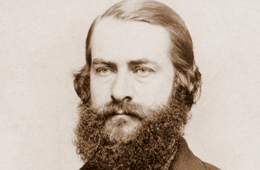
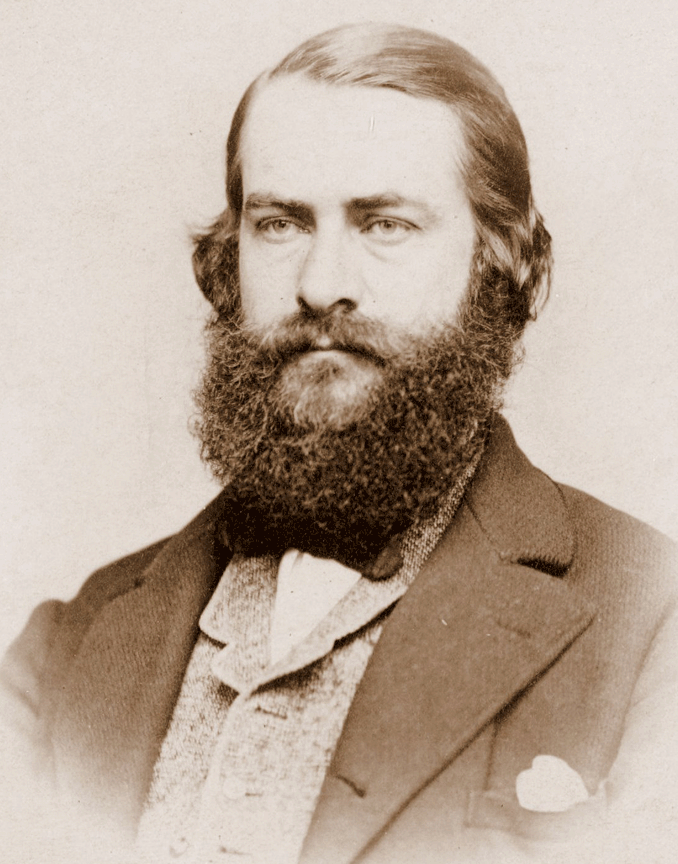
Joseph Mellick Leidy
Joseph Mellick Leidy was born in Philadelphia in 1823 to a Pennsylvania Dutch family whose quiet steadiness shaped him as much as his education did. His mother died giving birth to his younger brother when Leidy was only a year and a half old, and he was raised by his father and his stepmother, Christiana Mellick — his mother’s cousin — in a household that encouraged curiosity but expected discipline. When he entered the private school of William Mann, a Methodist clergyman, he showed little interest in the classical curriculum; instead, he slipped away into the rural edges of Philadelphia to collect minerals, plants, and insects, sketching them with the same care he would later bring to fossils. These unsanctioned excursions, which sometimes tempted him to skip lessons entirely, revealed the naturalist long before he qualified as doctor of medicine at the University of Pennsylvania in 1844.
Gentle, meticulous, and almost preternaturally even-tempered, Leidy stood apart from the theatrical rivalries that came to define American science in the late nineteenth century. He preferred quiet observation to polemic, and colleagues often remarked on his serenity — a quality that made him widely respected but sometimes overshadowed. When the feud between Edward Drinker Cope and Othniel Charles Marsh erupted into the Bone Wars, Leidy recoiled from the acrimony and withdrew from western fossil collecting rather than be drawn into their escalating hostilities. His habits were those of an old-style naturalist: early rising, steady work, careful drawing, and a belief that clarity mattered more than spectacle. Even his celebrated forensic moment — using a microscope to distinguish human from chicken blood in a murder case, effectively becoming the first person in the United States to help solve a homicide with microscopic evidence — reflected his instinct for precise, unshowy problem-solving. And in one of the era's most famous scientific corrections, he recognized that Cope — once his student — had mistakenly placed the head of Elasmosaurus on the end of its tail, an irony sharpened by the fact that Leidy himself had earlier misinterpreted the orientation of vertebrae in the pliosaur-like Cimoliasaurus.
Across close to six hundred publications, Leidy helped lay the foundations of American vertebrate paleontology, parasitology, comparative anatomy, and microscopy. He described Hadrosaurus foulkii, the first nearly complete dinosaur skeleton found in North America, and correctly inferred its bipedal stance; his landmark 1869 monograph Extinct Fauna of Dakota and Nebraska—hailed by Henry Fairfield Osborn as possibly "the most important palaeontological work which America has produced"—introduced many previously unknown species and helped establish vertebrate palaeontology as a formal discipline in the United States; and moved effortlessly between influential works on fungi, badland geology, rhizopods, molluscs, plants, vertebrate anatomy, the life cycle of bees, and intestinal parasites — often in the same season, sometimes in the same month — determining as early as 1846 that trichinosis was caused by a parasite in undercooked meat. His institutional life was equally substantial: elected to the Academy of Natural Sciences of Philadelphia in 1845, he served successively as its librarian, chairman of the board of curators, and ultimately its president, and during the American Civil War he worked as surgeon to the vast Satterlee Military Hospital. In 1864 he married Anna Harden, who shared his interest in natural history and whom he publicly thanked on several occasions for her assistance with his work. Five years later he began a long tenure as Professor of Natural History at Swarthmore College, teaching mineralogy and geology, and in 1888 he was chosen as the founding president of the Association of American Anatomists. His Elementary Treatise on Human Anatomy became a standard medical text, written because he believed his students deserved a clearer, more practical guide than any then available. By the time of his death in 1891, Leidy had become the model of the American naturalist-scholar — a scientist whose breadth, precision, and quiet integrity shaped disciplines that would grow far beyond anything he could have imagined.
His name endures on the Wyoming landscape as Mount Leidy, bestowed in his honour during the Hayden Survey of 1872.
Gentle, meticulous, and almost preternaturally even-tempered, Leidy stood apart from the theatrical rivalries that came to define American science in the late nineteenth century. He preferred quiet observation to polemic, and colleagues often remarked on his serenity — a quality that made him widely respected but sometimes overshadowed. When the feud between Edward Drinker Cope and Othniel Charles Marsh erupted into the Bone Wars, Leidy recoiled from the acrimony and withdrew from western fossil collecting rather than be drawn into their escalating hostilities. His habits were those of an old-style naturalist: early rising, steady work, careful drawing, and a belief that clarity mattered more than spectacle. Even his celebrated forensic moment — using a microscope to distinguish human from chicken blood in a murder case, effectively becoming the first person in the United States to help solve a homicide with microscopic evidence — reflected his instinct for precise, unshowy problem-solving. And in one of the era's most famous scientific corrections, he recognized that Cope — once his student — had mistakenly placed the head of Elasmosaurus on the end of its tail, an irony sharpened by the fact that Leidy himself had earlier misinterpreted the orientation of vertebrae in the pliosaur-like Cimoliasaurus.
Across close to six hundred publications, Leidy helped lay the foundations of American vertebrate paleontology, parasitology, comparative anatomy, and microscopy. He described Hadrosaurus foulkii, the first nearly complete dinosaur skeleton found in North America, and correctly inferred its bipedal stance; his landmark 1869 monograph Extinct Fauna of Dakota and Nebraska—hailed by Henry Fairfield Osborn as possibly "the most important palaeontological work which America has produced"—introduced many previously unknown species and helped establish vertebrate palaeontology as a formal discipline in the United States; and moved effortlessly between influential works on fungi, badland geology, rhizopods, molluscs, plants, vertebrate anatomy, the life cycle of bees, and intestinal parasites — often in the same season, sometimes in the same month — determining as early as 1846 that trichinosis was caused by a parasite in undercooked meat. His institutional life was equally substantial: elected to the Academy of Natural Sciences of Philadelphia in 1845, he served successively as its librarian, chairman of the board of curators, and ultimately its president, and during the American Civil War he worked as surgeon to the vast Satterlee Military Hospital. In 1864 he married Anna Harden, who shared his interest in natural history and whom he publicly thanked on several occasions for her assistance with his work. Five years later he began a long tenure as Professor of Natural History at Swarthmore College, teaching mineralogy and geology, and in 1888 he was chosen as the founding president of the Association of American Anatomists. His Elementary Treatise on Human Anatomy became a standard medical text, written because he believed his students deserved a clearer, more practical guide than any then available. By the time of his death in 1891, Leidy had become the model of the American naturalist-scholar — a scientist whose breadth, precision, and quiet integrity shaped disciplines that would grow far beyond anything he could have imagined.
His name endures on the Wyoming landscape as Mount Leidy, bestowed in his honour during the Hayden Survey of 1872.
More Leidy
• Leidy J (1858) "On the bones of a huge herbivorous saurian near Haddonfield". Proceedings of the Academy of Natural Sciences of Philadelphia, 10: 215-218.
• Leidy J (1859) "Hadrosaurus foulkii, a new saurian from the Cretaceous of New Jersey". The American Journal of Science and Arts, 2(27): 266-270.
• Leidy J (1869) "The extinct mammalian fauna of Dakota and Nebraska: Including an account of some allied forms from other localities, together with a synopsis of the mammalian remains of North America".
• Leidy J (March 8, 1870) "Remarks on Elasmosaurus platyurus". Proc. Acad. Nat. Sci. Phila. 22. Philadelphia: Academy of Natural Sciences (web site maintained by M. J. Everhart): 9–10.
• Marsh OC (January 19, 1890) "Wrong End Foremost". New York Herald.
• Chapman HC (1891) "Memoir of Joseph Leidy, M.D., LL.D". Proceedings of the Academy of Natural Sciences of America, Academy of Natural Sciences, Philadelphia: 31–49.
• Gannett, Henry (1905) "The Origin of Certain Place Names in the United States". U.S. Government Printing Office: 184.
• Osborn HF (1913) "Biographical Memoir of Joseph Leidy
1823-1891". National Academy of Sciences.
Biographical Memoirs.
Part OF Volume VII.
• Hare HA (1923) "Leidy and His Influence on Medical Science". Proceedings of the Academy of Natural Sciences of Philadelphia, 75: 73-87.
• Warren L (1998) "Joseph Leidy: The Last Man Who Knew Everything".
• The Academy of Natural Sciences "Joseph Leidy: Biographical Time Line".
Discoveries and descriptions ...
| Name | Type |
|---|---|
| ANTRODEMUS |  |
| ASTRODON |  |
| HADROSAURUS |  |
| TROODON |  |


