
Pronunciation: kaw-dip-teh-ruh-day
Author: Zhou and Wang
Year: 2000
Meaning: Caudipteryx family (see etymology)
Locomotion: Bipedal (two legs)
Synonyms: Caudipterygidae (Osmolska et al., 2004)
Definition
Not officially defined.
About
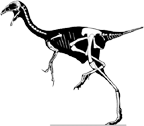
Caudipteridae is a family of oviraptorosaurs known only from Aptian-aged (Early Cretaceous, 125-120 mya) Formations in China, who are typified by a unique dagger-shaped pygostyle: the bone at the tip of the tail in birds, used to anchor a "fan" of feathers.
It was was named in 2000 to house Caudipteryx and its closest relatives, which at the time ammounted to just two species of Caudipteryx, and given that a family isn't really a family unless it houses at least a couple of genera it was a bit pointless. Nevertheless, Caudipteridae was unfathomably renamed Caudipterygidae by Osmolska, Currie and Barsbold in 2004, four years before the second and still only other member, the creatively-named Similicaudipteryx (similar to Caudipteryx) was coined. Most palaeontologists still use Caudipteridae, anyway.
Click here to search Dinochecker for caudipterids.
Etymology
Caudipteridae is derived from the Latin "cauda" (tail), the Greek "pteryx" (wing, feather) and the Latin "idae" (family), named for the group anchor, Caudipteryx, whose stumpy tail sports a fan-like arrangement of large feathers.
Relationships
References
• Zhou Z and Wang X (2000) "A new species of Caudipteryx from the Yixian Formation of Liaoning, northeast China". Vertebrata PalAsiatica, 38(2): 111-127.