Pronunciation: jay-HOLL-o-SOR-ruh-day
Author: Han, Barrett, Butler and Xu
Year: 2012
Meaning: Jehol lizards (see etymology)
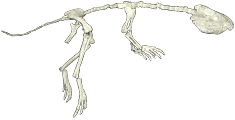
Locomotion: Bipedal (two legs)
Synonyms: None known
[Han et al. 2012]Definition
All ornithischians more closely related to Jeholosaurus shangyuanensis than to Hypsilophodon foxii, Iguanodon bernissartensis, Protoceratops andrewsi, Pachycephalosaurus wyomingensis, or Thescelosaurus neglectus.
About
Coming soon. In the meantime, click here to search Dinochecker for instances of Jeholosauridae.
Etymology
Jeholosauridae is derived from "Jeholosaurus" (the "Jehol lizard"—the oldest member and group anchor) and the Greek "idae" (family).
Relationships
Further reading
• Xu X, Wang X and You H-L (2000) "A primitive ornithopod from the Early Cretaceous Yixian Formation of Liaoning". Vertebrata Palasiatica, 38: 318-325.
• Makovicky PJ, Kilbourne BM, Sadleir RW and Norell MA (2011) "A new basal ornithopod (Dinosauria, Ornithischia) from the Late Cretaceous of Mongolia" Journal of Vertebrate Paleontology, 31(3): 626-540. [recovers Jeholosaurus as a close relative of Haya griva].
• Paul GS (2010) "The Princeton Field Guide to Dinosaurs".
• Han F-L, Barrett PM, Butler RJ and Xu X (2012) "Postcranial anatomy of Jeholosaurus shangyuanensis (Dinosauria, Ornithischia) from the Lower Cretaceous Yixian Formation of China" Journal of Vertebrate Paleontology, 32(6): 1370-1395 [coins "Jeholosauridae"].
• Hu J, Xu X, Li F and Han F (2024) "Tooth replacement in the early-diverging neornithischian Jeholosaurus shangyuanensis and implications for dental evolution and herbivorous adaptation in Ornithischia". BMC Ecology and Evolution, 24: 46. DOI: 10.1186/s12862-024-02233-2.
.