Pronunciation: yoo-na-hee-sor-uh-day
Authors: Müller, Langer and Dias-da-Silva
Year: 2018
Meaning: Unaysaurus family (see etymology)
Locomotion: Bipedal (two legs)
Synonyms: None known
[Müller, Langer and Dias-da-Silva]Definition
The most inclusive clade including Unaysaurus tolentinoi, but not Plateosaurus engelhardti nor Saltasaurus loricatus.
About
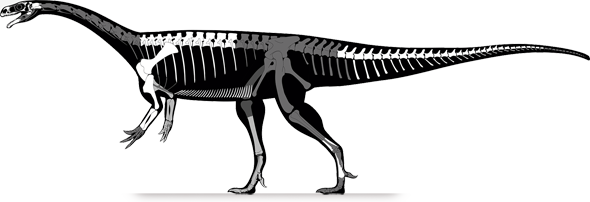
Unaysauridae is a proposed group of early sauropodomorph dinosaurs from the Late Triassic of Brazil, though its validity remains uncertain: the clade is defined by just two features — a distinctive expansion on the ankle bone and a small opening in the upper jaw — yet neither trait is present in all of the animals traditionally assigned to it. Because these supposed diagnostic characters are inconsistent or missing, some palaeontologists question whether Unaysauridae is a natural group at all and instead place its members within the broader, more stable Plateosauridae.Click here to view Dinochecker's A-Z list of unaysaurids.
Etymology
Unaysauridae is derived from the Tupi word "unay" (pronounced yoo-na-hee, meaning "black water", which in turn refers to Agua Negra [also "black water"], the Portuguese name for the region where the fossils were found), the Greek "sauros" (lizard) and the Latin "-idae" (family). This group is named after the flag-bearer Unaysaurus tolentinoi. References
• Müller RD, Langer MC and Dias-da-Silva S (2018) "An exceptionally preserved association of complete dinosaur skeletons reveals the oldest long-necked sauropodomorphs". Biology Letters, 14(11): 20180633. DOI: 10.1098/rsbl.2018.0633.
• Beccari V, Mateus O, Wings O, Milàn J and Clemmensen LB (2021) "Issi saaneq gen. et sp. nov.—A New Sauropodomorph Dinosaur from the Late Triassic (Norian) of Jameson Land, Central East Greenland". Diversity, 13(11): 561. DOI: 10.3390/d13110561.