



Date of Birth: May 24, 1793
Place of Birth: Deerfield, Massachusetts, USA
Parents: Justin Hitchcock and Mercy Hoyt
Spouse: Orra White Hitchcock
Died: February 27, 1864
Place of death: Amherst, Massachusetts
Legacy: Dinosaur trackways in Conneticut
Edward Hitchcock
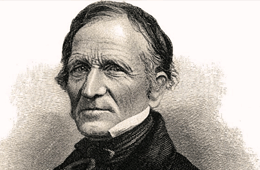
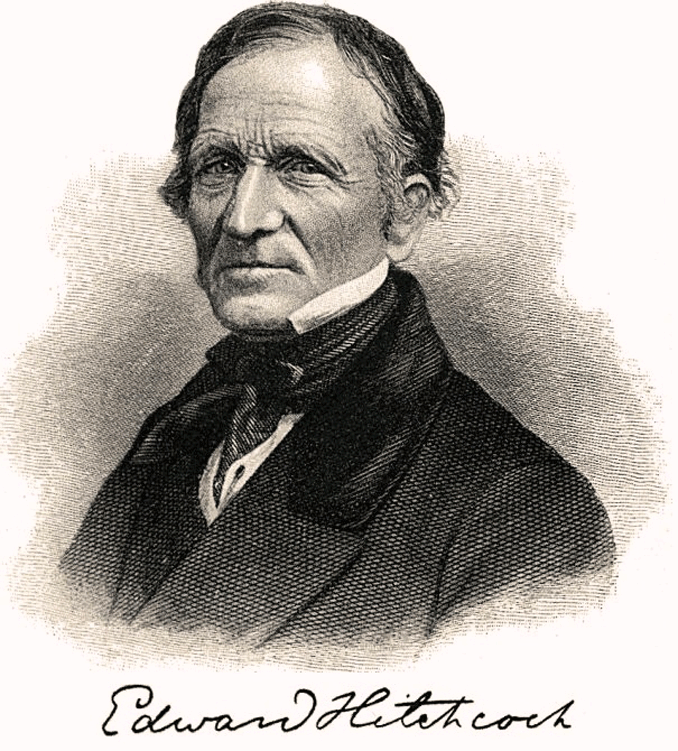
Edward Hitchcock was born on 24 May 1793 in Deerfield, Massachusetts, into a modest New England family shaped by Congregationalist traditions. After attending Deerfield Academy—where he later served as principal—he studied divinity at Yale and was ordained in 1821. His pastoral work in Conway, Massachusetts, ran in parallel with a growing fascination for natural history, and he soon began collecting minerals, plants, and fossils from the surrounding region. In 1825 he joined Amherst College as Professor of Chemistry and Natural History, eventually becoming its president in 1845. There he fused his training in the ministry with the practical demands of teaching natural science, helping to build one of the earliest and most influential geology programs in the United States.
Hitchcock was known for his meticulous field habits. His notebooks reveal a characteristic blend of observational precision and reflective commentary, a synthesis that marked much early nineteenth-century American natural science. He was also a gifted teacher and public lecturer, admired for his ability to communicate geological ideas clearly to students, clergy, and general audiences, making complex concepts accessible without sacrificing scientific depth.
His most enduring contribution was his monumental study of the Connecticut Valley fossil trackways, begun in the 1830s and pursued with extraordinary persistence for decades. Hitchcock catalogued thousands of individual footprints and long, continuous track sequences, documenting their dimensions, stride lengths, and patterns of movement with a rigor unmatched in his era. From these observations he concluded—based on the narrow, elongate toes, consistent bipedal gait, and absence of tail drag marks—that the trackmakers were giant prehistoric birds rather than reptiles, an interpretation that, while not taxonomically correct, was remarkably prescient in recognizing the fundamentally bird-like anatomy and posture of theropod dinosaurs. He established the first systematic ichnological classification in North America and assembled the remarkable Ichnological Cabinet at Amherst, a collection that remains one of the most important historical assemblages of fossil track material in the world. In Elementary Geology (1840), he inserted a paleontological chart—what he himself called a "tree"—that arranged the plant and animal kingdoms against a backdrop of geological time, thus creating the earliest known palaeontology-based "tree of life". Although Hitchcock rejected species transmutation and interpreted the tree as a record of successive divine creations, the diagram stands as a foundational moment in the visual history of biology.
Beyond ichnology, Hitchcock shaped early American geology through statewide surveys, museum building, and public education. He served as State Geologist of Massachusetts and contributed to surveys in New York and Vermont. His wife Orra, with whom he had six children, was one of the most accomplished scientific illustrators of her generation and frequently enhanced his publications with visual plates and diagrams, while their son Edward "Doc" Hitchcock Jr. named one of the earliest dinosaurs discovered in North America—Megadactylus polyzelus—a name later found to be preoccupied and replaced by Amphisaurus... which was later found to be preoccupied and replaced with Anchisaurus. Edward Hitchcock died on 27 February 1864 in Amherst, leaving behind a legacy defined by pioneering ichnological work, a distinctive theological approach to Earth's deep history, and a reluctance to speculate beyond observable evidence.
Mount Hitchcock in the Holyoke Range of Massachusetts, and the prehistoric Lake Hitchcock, which once filled the valley from Connecticut to Vermont, were named in his honour.
Hitchcock was known for his meticulous field habits. His notebooks reveal a characteristic blend of observational precision and reflective commentary, a synthesis that marked much early nineteenth-century American natural science. He was also a gifted teacher and public lecturer, admired for his ability to communicate geological ideas clearly to students, clergy, and general audiences, making complex concepts accessible without sacrificing scientific depth.
His most enduring contribution was his monumental study of the Connecticut Valley fossil trackways, begun in the 1830s and pursued with extraordinary persistence for decades. Hitchcock catalogued thousands of individual footprints and long, continuous track sequences, documenting their dimensions, stride lengths, and patterns of movement with a rigor unmatched in his era. From these observations he concluded—based on the narrow, elongate toes, consistent bipedal gait, and absence of tail drag marks—that the trackmakers were giant prehistoric birds rather than reptiles, an interpretation that, while not taxonomically correct, was remarkably prescient in recognizing the fundamentally bird-like anatomy and posture of theropod dinosaurs. He established the first systematic ichnological classification in North America and assembled the remarkable Ichnological Cabinet at Amherst, a collection that remains one of the most important historical assemblages of fossil track material in the world. In Elementary Geology (1840), he inserted a paleontological chart—what he himself called a "tree"—that arranged the plant and animal kingdoms against a backdrop of geological time, thus creating the earliest known palaeontology-based "tree of life". Although Hitchcock rejected species transmutation and interpreted the tree as a record of successive divine creations, the diagram stands as a foundational moment in the visual history of biology.
Beyond ichnology, Hitchcock shaped early American geology through statewide surveys, museum building, and public education. He served as State Geologist of Massachusetts and contributed to surveys in New York and Vermont. His wife Orra, with whom he had six children, was one of the most accomplished scientific illustrators of her generation and frequently enhanced his publications with visual plates and diagrams, while their son Edward "Doc" Hitchcock Jr. named one of the earliest dinosaurs discovered in North America—Megadactylus polyzelus—a name later found to be preoccupied and replaced by Amphisaurus... which was later found to be preoccupied and replaced with Anchisaurus. Edward Hitchcock died on 27 February 1864 in Amherst, leaving behind a legacy defined by pioneering ichnological work, a distinctive theological approach to Earth's deep history, and a reluctance to speculate beyond observable evidence.
Mount Hitchcock in the Holyoke Range of Massachusetts, and the prehistoric Lake Hitchcock, which once filled the valley from Connecticut to Vermont, were named in his honour.
More Hitchcock
• Pick N and Ward F (2006) "Curious Footprints: Professor Hitchcock's Dinosaur Tracks & Other Natural History Treasures at Amherst College".
• Archibald JD (2009) "Edward Hitchcock's Pre-Darwinian (1840) 'Tree of Life'". Journal of the History of Biology, 42: 561-592.
• McMaster RT (2021) "All the Light Here Comes from Above: The Life and Legacy of Edward Hitchcock".
• Linda Hall Library. "First North American Fossils: Footprints in New England, 1858". Paper Dinosaurs.
• Michigan State University. "Hitchcock, Edward, 1793-1864". MSU Libraries. Digital Repository.
• Amherst College Library "Edward and Orra White Hitchcock Papers". Digital Archives & Special Collections.
Discoveries and descriptions ...
| Name | Type |
|---|


