








Date of Birth: August 16, 1848
Place of Birth: Jamaica, West Indies
Parents: Rev. Francis R. Holland and Eliza Augusta Wolle
Spouse: Carrie T. Moorhead
Date of expiry: December 13, 1932 (aged 84)
Place of expiry: Pittsburgh, Pennsylvania, USA
Legacy: Institutional builder and cultural diplomat, who expanded Carnegie Museum into a world class research centre and placed Diplodocus casts worldwide.
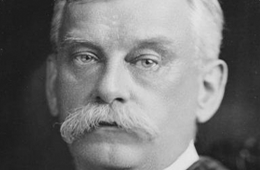
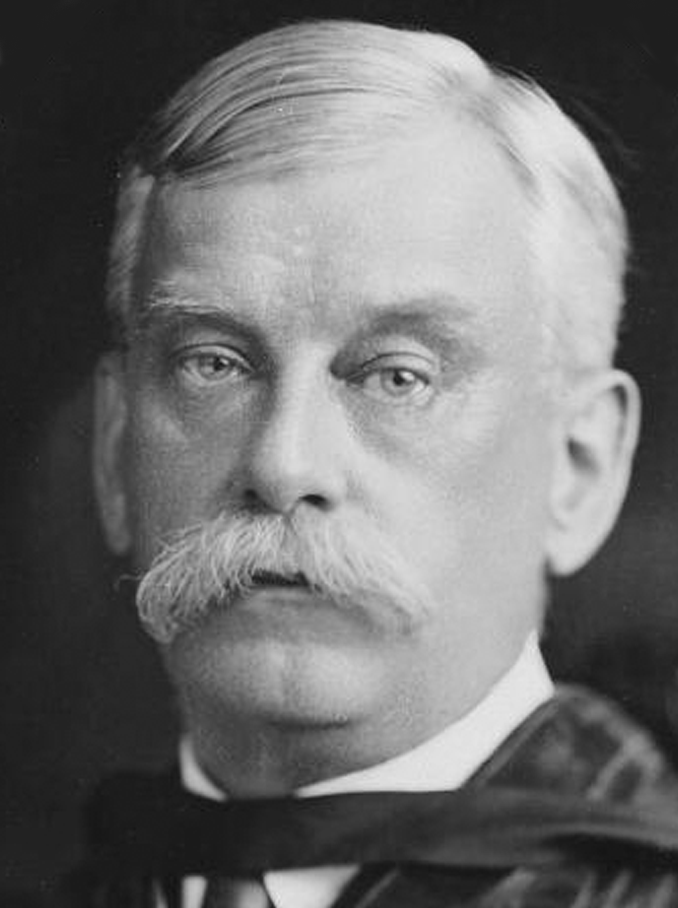
William Jacob Holland
William Jacob Holland was born in 1848 in Jamaica, the son of American Moravian missionary parents, but was educated in the United States after his family returned there from the Caribbean. He studied classical languages, philosophy, and the natural sciences at Amherst College, then trained for the ministry at Princeton Theological Seminary. Upon ordination, he accepted a call to the Bellefield Presbyterian Church in Pittsburgh's Oakland neighborhood, beginning a seventeen?year pastorate that ran alongside his expanding scientific interests. During this period he also served as a trustee of the Pennsylvania College for Women (now Chatham University), where he taught ancient languages. Holland’s early career blended theology, classical scholarship, and natural history — an eclectic foundation that shaped his later roles as Chancellor of the University of Pittsburgh and, ultimately, as Director of the Carnegie Museum.
Holland was a deft administrator with a gift for diplomacy. He cultivated relationships with European scientific institutions, managed large and sometimes fractious research staffs, and navigated the competing expectations of trustees, donors, and curators with practiced tact. His correspondence reveals a leader keenly aware of the political dimensions of museum science, and one who occasionally clashed with researchers over credit, authority, and the public presentation of discoveries. He gained early scientific experience as a naturalist on the 1887 U.S. Eclipse Expedition to Japan, which broadened his international connections, and developed a deep expertise in Lepidoptera — the study of moths and butterflies — eventually becoming one of America’s leading authorities in the field.
Though not a fieldworker himself, Holland grasped the symbolic power of fossils — especially dinosaurs — and used them strategically to elevate the Carnegie Museum's international standing. As director, Holland presided over the golden age of vertebrate palaeontology, overseeing the preparation and global distribution of the celebrated Diplodocus carnegii casts. These replicas — sent to London, Paris, Berlin, Vienna, and other capitals — became instruments of scientific diplomacy and transformed "Dippy" into a cultural icon. Holland expanded the museum's collections, championed ambitious exhibition projects, and authored influential works in entomology, the field in which he was most scientifically active. His legacy is institutional rather than field-based: he helped shape the Carnegie Museum into a world-class research centre and demonstrated how museums could wield natural history as a tool of international prestige.
Holland was a deft administrator with a gift for diplomacy. He cultivated relationships with European scientific institutions, managed large and sometimes fractious research staffs, and navigated the competing expectations of trustees, donors, and curators with practiced tact. His correspondence reveals a leader keenly aware of the political dimensions of museum science, and one who occasionally clashed with researchers over credit, authority, and the public presentation of discoveries. He gained early scientific experience as a naturalist on the 1887 U.S. Eclipse Expedition to Japan, which broadened his international connections, and developed a deep expertise in Lepidoptera — the study of moths and butterflies — eventually becoming one of America’s leading authorities in the field.
Though not a fieldworker himself, Holland grasped the symbolic power of fossils — especially dinosaurs — and used them strategically to elevate the Carnegie Museum's international standing. As director, Holland presided over the golden age of vertebrate palaeontology, overseeing the preparation and global distribution of the celebrated Diplodocus carnegii casts. These replicas — sent to London, Paris, Berlin, Vienna, and other capitals — became instruments of scientific diplomacy and transformed "Dippy" into a cultural icon. Holland expanded the museum's collections, championed ambitious exhibition projects, and authored influential works in entomology, the field in which he was most scientifically active. His legacy is institutional rather than field-based: he helped shape the Carnegie Museum into a world-class research centre and demonstrated how museums could wield natural history as a tool of international prestige.
References
• Holland WJ (1898) "The butterfly book : a popular guide to a knowledge of the butterflies of North America".
• Holland WJ (1903) "The moth book a popular guide to a knowledge of the moths of North America".
• Holland WJ (1913) "To the River Plate and Back: The Narrative of a Scientific Mission to South America, with Observations on Things Seen and Suggested".
• "Dr. Holland Laid to Rest". Pittsburgh Post-Gazette.
Discoveries and descriptions ...
| Name | Type |
|---|


