



Date of Birth: June 20, 1974 (age 51)
Place of Birth: Sikeston, Missouri, U.S.A.
Parents: Terry and Pat Curry
Spouse: Raymond Rogers
Date of expiry: n/a
Place of expiry: n/a
Legacy: A pioneer of titanosaur biology and life history studies, who brought Madagascar’s Cretaceous ecosystems into focus.
Kristina Curry Rogers
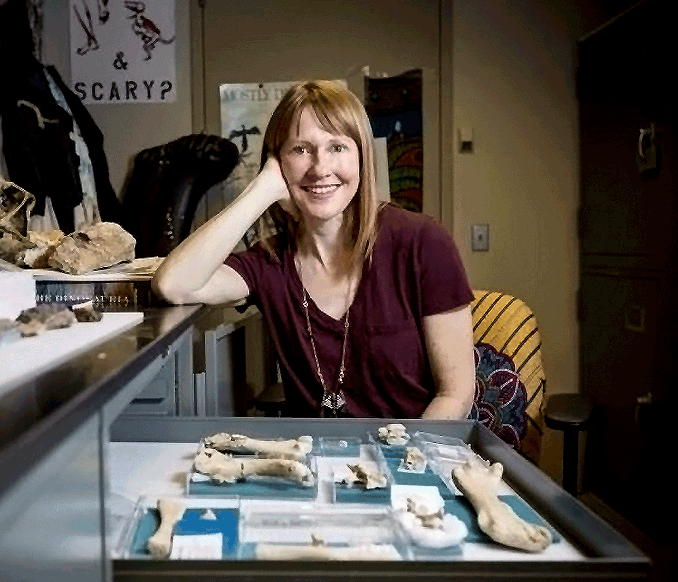
Kristina (Kristi) Curry Rogers was born in Sikeston, Missouri, in 1974, the daughter of Terry Curry, a second-grade public school teacher, and Pat Curry, the band director for Sikeston Public Schools. She developed an early interest in Earth sciences that led her to pursue undergraduate studies in paleontology at Montana State University. She earned both her M.S. and Ph.D. in Anatomical Sciences at Stony Brook University in 2001, working under the mentorship of Catherine Forster and David W. Krause. After earning her doctorate, she was appointed Curator of Paleontology at the Science Museum of Minnesota (2001–2008). She later joined Macalester College, where she held a joint appointment in Biology and Geology, served as Chair of Biology from 2019–2022, and in 2023 was named a Dewitt Wallace Professor of Biology and Geology. Her excellence in the classroom was formally recognized with the Macalester College Jack and Marty Rossman Excellence in Teaching Award in 2015. She is married to fellow Macalester geologist Ray Rogers, and together they have two daughters.
Curry Rogers is widely recognized for her clarity, precision, and ability to communicate complex science to broad audiences. Her work blends bone histology, anatomical description, and field research, reflecting a commitment to understanding dinosaurs as living organisms with complex growth histories and ecological roles. She is known for her collaborative style, and has built long-standing research partnerships in both the laboratory and the field. Decades of work in the Maevarano Formation of Madagascar have made her a central figure in reconstructing the Late Cretaceous ecosystems of the island, and her public communication—through teaching, museum work, and outreach—has earned her a reputation as a clear and engaging interpreter of paleontological science.
Curry Rogers is best known as the co-describer of the titanosaur Rapetosaurus krausei (2001), a landmark discovery that helped illuminate the anatomy, growth, and life history of Late Cretaceous sauropods. Her research has advanced understanding of titanosaur ontogeny, bone microstructure, and evolutionary diversity, and she has played a major role in clarifying how giant sauropods grew, matured, and interacted with their environments. Through her combined roles as researcher, teacher, curator, and field scientist, she has shaped both scholarly perspectives on sauropod biology and public understanding of dinosaur evolution, leaving a lasting influence on the study of sauropod growth and the paleobiology of Madagascar.
Curry Rogers is widely recognized for her clarity, precision, and ability to communicate complex science to broad audiences. Her work blends bone histology, anatomical description, and field research, reflecting a commitment to understanding dinosaurs as living organisms with complex growth histories and ecological roles. She is known for her collaborative style, and has built long-standing research partnerships in both the laboratory and the field. Decades of work in the Maevarano Formation of Madagascar have made her a central figure in reconstructing the Late Cretaceous ecosystems of the island, and her public communication—through teaching, museum work, and outreach—has earned her a reputation as a clear and engaging interpreter of paleontological science.
Curry Rogers is best known as the co-describer of the titanosaur Rapetosaurus krausei (2001), a landmark discovery that helped illuminate the anatomy, growth, and life history of Late Cretaceous sauropods. Her research has advanced understanding of titanosaur ontogeny, bone microstructure, and evolutionary diversity, and she has played a major role in clarifying how giant sauropods grew, matured, and interacted with their environments. Through her combined roles as researcher, teacher, curator, and field scientist, she has shaped both scholarly perspectives on sauropod biology and public understanding of dinosaur evolution, leaving a lasting influence on the study of sauropod growth and the paleobiology of Madagascar.
References
• Curry KA (13 December 1999) "Ontogenetic histology of Apatosaurus (Dinosauria: Sauropoda): New insights on growth rates and longevity". Journal of Vertebrate Paleontology. 19 (4): 654–665. DOI: 10.1080/02724634.1999.10011179.
• Curry Rogers K and Forster CA (2001) "The last of the dinosaur titans: a new sauropod from Madagascar". Nature, 412(6846): 530–534. DOI: 10.1038/35087566.
• Curry Rogers K (2001) "Growth Rates among the dinosaurs". Page 297–309 in Paul (ed.) "The Scientific American Book of Dinosaurs".
• Rogers RR, Krause DW and Curry Rogers K (2003) "Cannibalism in the Madagascan dinosaur Majungatholus atopus". Nature, 422: 515-518. DOI: 10.1038/nature01532.
• Curry Rogers K and Forster CA (2004) "The skull of Rapetosaurus krausei (Sauropoda: Titanosauria) from the Late Cretaceous of Madagascar". Journal of Vertebrate Paleontology 24(1): 121–143. DOI: 10.1671/A1109-10.
• Curry Rogers K and Wilson JA (2005) "The Sauropods: Evolution and Paleobiology".
• Curry Rogers K (2009) "The postcranial anatomy of Rapetosaurus krausei (Sauropoda: Titanosauria)". Journal of Vertebrate Paleontology, 29: 1046-1086. DOI: 10.1671/039.029.0432.
• Wilson JA and Curry Rogers K (2012) "The Sauropods". Page 444-481 in Brett-Surman, Holtz and Farlow (eds.) "The Complete Dinosaur: Second Edition".
• Curry Rogers K and D'Emic M (2012) "Triumph of the Titans". Scientific American, 306(5): 48-55.
• Curry Rogers K and Wilson JA (2014) "Vahiny depereti gen. et sp. nov., a new titanosaur from the Upper Cretaceous Maevarano Formation, Madagascar". Journal of Vertebrate Paleontology 34: 606-617. DOI: 10.1080/02724634.2013.822874.
• Curry Rogers K, Whitney M, D'Emic M and Bagley B (2016) "Precocity in a tiny titanosaur from the Late Cretaceous of Madagascar". Science, 352: 450-454. DOI: 10.1126/science.aaf1509.
• Curry Rogers K and Kulik Z (2018) "Osteohistology of Rapetosaurus krausei (Sauropoda: Titanosauria) from the Upper Cretaceous of Madagascar". Journal of Vertebrate Paleontology, 38(4): 1–24. DOI: 10.1080/02724634.2018.1493689.
Discoveries and descriptions ...
| Name | Type |
|---|---|
| RAPETOSAURUS |  |
| VAHINY | |


