


Pronunciation: THES-kel-o-SOR-uh-nay
Author: Charles M. Sternberg
Year: 1940
Meaning: Wondrous lizards (see etymology)
Locomotion: Bipedal (2 legs)
Synonyms: None known
Author: Charles M. Sternberg
Year: 1940
Meaning: Wondrous lizards (see etymology)
Locomotion: Bipedal (2 legs)
Synonyms: None known
[Brown et al. 2013]Definition
All thescelosaurids more closely related to
Thescelosaurus neglectus than to Orodromeus makelai.
About
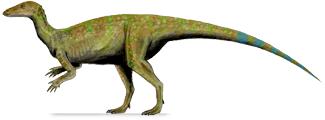
Thescelosaurinae represents the larger and more robust branch of Thescelosauridae. While their orodromine relatives retained smaller body sizes and developed some of the clearest anatomical evidence for fossorial habits, thescelosaurines evolved into sturdier herbivores that occupied a wider range of habitats. Their fossil record is particularly well documented in North America, where they became established members of Late Cretaceous dinosaur communities and successful components of ecosystems increasingly dominated by hadrosaurids and ceratopsians.
Like other thescelosaurids, thescelosaurines possessed fused premaxillae and an expanded scapula, but they tended toward larger body sizes and more robust proportions. They retained the selective feeding strategy characteristic of the clade, with relatively small skulls and feeding systems adapted for processing soft vegetation rather than large quantities of coarse plant matter. Their long, low snouts may likewise have been useful for browsing selectively among low shrubs and ground-level vegetation. Although generally less specialised than orodromines, thescelosaurines shared many of the anatomical features that have been interpreted as adaptations for digging and interaction with the substrate.
Thescelosaurines reached their peak during the final stages of the Cretaceous. Thescelosaurus, the largest known thescelosaurid, lived alongside hadrosaurids, ceratopsians, ankylosaurs, and tyrannosaurids in some of the last dinosaur-dominated ecosystems on Earth. Recent studies of its braincase suggest an animal that relied more on smell and spatial awareness than on complex cognition, possessing unusually developed olfactory regions and balance organs but relatively limited hearing. Combined with anatomical evidence elsewhere in the skeleton and the burrowing traces associated with earlier thescelosaurids, these findings are consistent with a lineage well adapted to life close to the ground and possibly interacting extensively with burrows or other sheltered environments. Because thescelosaurines survived until the end-Cretaceous extinction, they provide an important window into the structure of dinosaur communities immediately before their disappearance.
Click here to search the database for thescelosaurines.
Etymology
Thescelosaurinae is derived from the Greek "theskelos" (wonderful, surprising) and "sauros" (lizard), and the Latin "-inae" (subfamily).
Relationships
References
• Sternberg CM (1940) "Thescelosaurus edmontonensis, n. sp., and classification of the Hypsilophodontidae".
Journal of Paleontology, 14(5): 481-494.
• Sues H-D and Norman DB (1990) "Hypsilophodontidae, Tenontosaurus, Dryosauridae". In Weishampel, Dodson and Osmólska (eds.) "The Dinosauria: First Edition".
• Norman DB, Sues H-D, Witmer LM and Coria RA (2004) "Basal Ornithopoda". In Weishampel, Dodson and Osmólska (eds.) "The Dinosauria: Second Edition".
• Varricchio DJ, Martin AJ and Katsura Y (2007) "First trace and body fossil evidence of a burrowing, denning dinosaur". Proceedings of the Royal Society B: Biological Sciences, 274 (1616): 1361–1368. DOI: 10.1098/rspb.2006.0443.
• Holtz jr TR (2008) "The Most Complete, Up-to-Date Encyclopedia for Dinosaur Lovers of All Ages".
• Brown CM, Evans DC, Ryan MJ and Russell AP (2013) "New data on the diversity and abundance of small-bodied ornithopods (Dinosauria, Ornithischia) from the Belly River Group (Campanian) of Alberta". Journal of Vertebrate Paleontology, 33(3): 495-520.
DOI: 10.1080/02724634.2013.746229.
• Madzia D, Arbour VM, Boyd CA, Farke AA, Cruzado-Caballero P and Evans DC (2021) "The phylogenetic nomenclature of ornithischian dinosaurs". PeerJ, 9: e12362. DOI: 10.7717/peerj.12362.
• Wyenberg-Henzler T, Patterson RT and Mallon JC (2022) "Size-mediated competition and community structure in a Late Cretaceous herbivorous dinosaur assemblage". Historical Biology, 34(11): 2230-2240. DOI: 10.1080/08912963.2021.2010191.
• Button DJ and Zanno LE (2023) "Neuroanatomy of the late Cretaceous Thescelosaurus neglectus (Neornithischia: Thescelosauridae) reveals novel ecological specialisations within Dinosauria". Scientific Reports, 13(1): 19224. DOI: 10.1038/s41598-023-45658-3.
• Holtz TR (2026) "Thescelosauridae and Ornithopoda: Beaks, bills and crests". GEOL 104: Dinosaurs — A Natural History. University of Maryland.


